TL;DR:A Force Majeure Clause is your contract's insurance policy against the unforeseeable. Draft it tight, list your events explicitly, set a clear threshold, and don't forget the notice and mitigation machinery. The parties that weathered COVID-19 best weren't the ones with the best lawyers in court - they were the ones whose force majeure clauses were well-drafted from the start.
Force majeure is French for "superior force". In contract law, the clause allocates risk when extraordinary, unforeseeable events disrupt a party's ability to perform. Without it, a party that fails to meet its obligations could face breach of contract claims, even if the failure was caused by a global pandemic or a government-imposed trade embargo.
The clause became the most litigated provision in commercial contracts during 2020-2021 when COVID-19 shut down supply chains, closed borders, and suspended entire industries. Courts worldwide had to decide whether a pandemic qualified as force majeure, and the results varied wildly depending on how the clause was drafted. That litigation wave exposed a hard truth: most force majeure clauses are either too vague to enforce or too narrow to cover the event that actually happened.
• Defines qualifying events (natural disasters, wars, pandemics, government actions, etc.).
• Sets the threshold - "impossibility," "impracticability," or "illegality."
• Requires timely notice and evidence from the affected party.
• Suspends obligations during the event, with a long-stop termination right.
• Imposes a duty to mitigate where commercially reasonable.
Impossibility vs. Impracticability
- Impossibility means the event has made performance literally impossible - the factory burned down, the government banned the product, or a key person died. This is the highest threshold and the hardest to invoke. Courts are strict: if there's any way to perform, even at a higher cost, impossibility doesn't apply.
- Impracticability is a lower bar. Performance is technically possible but has become so excessively burdensome - in cost, risk, or effort - that it would be unreasonable to require it. Think of a shipping contract where the usual route is blocked by a war: the goods could go the long way around, but at five times the cost. The UCC (Section 2-615) recognizes impracticability for goods contracts, and many common law jurisdictions apply it as well.
A well-drafted Force Majeure clause contains:
- Defined Trigger Events: A specific, enumerated list of qualifying events - natural disasters, wars, terrorism, pandemics, epidemics, government orders, sanctions, embargoes, strikes, labour disputes, utility failures, cyber-attacks. The more specific, the better.
- Threshold Standard: Whether relief requires impossibility, impracticability, or illegality. This single word can determine the outcome of a dispute.
- Causation Requirement: The event must directly prevent or hinder performance - not just make it inconvenient or more expensive. The affected party typically must show the event was beyond its reasonable control and not foreseeable at the time of contracting.
- Notice Obligations: How quickly the affected party must notify the other side (often 5-15 business days), what the notice must contain, and whether late notice waives the right to claim relief.
- Mitigation Duty: The affected party must take commercially reasonable steps to work around the event or reduce its impact. Sitting back and doing nothing while claiming force majeure is a fast way to lose the argument.
- Suspension & Termination Mechanics: Obligations are typically suspended - not extinguished - during the event. If the event continues beyond a long-stop period (often 60-180 days), either party may terminate without liability.
- Carve-Outs: Events that don't qualify - most commonly, payment obligations, financial hardship, changes in market conditions, or foreseeable risks the party assumed.
Market Position & Benchmarks
Where Does Your Clause Fall?
- Buyer/Recipient-Protective (Narrow FM): Requires strict impossibility, short enumerated event list, mandatory mitigation with reporting, no extension of deadlines, payment obligations never excused, short long-stop period (30-60 days) triggering buyer's termination right. The buyer retains maximum leverage and can exit quickly if the supplier cannot perform.
- Balanced/Market Standard: Impracticability threshold, broad enumerated list plus a catch-all ("any event beyond reasonable control"), mutual notice within 10 business days, mutual mitigation obligations, suspension of affected obligations during the FM event, long-stop termination at 90-120 days with either party able to terminate, payment obligations excluded from FM relief.
- Supplier/Performing Party-Protective (Broad FM): Low threshold ("hindered" or "delayed"), expansive event list including supply chain disruptions, labour shortages, and price increases, longer notice windows (30 days), limited mitigation requirements, extended long-stop period (180+ days), supplier retains right to allocate scarce resources among customers, payment obligations may be deferred during FM period.
Market Data
- Post-COVID, 78% of commercial contracts now include pandemic, epidemic, or public health emergency as an enumerated FM event, up from approximately 30% before 2020 (ACC/Deloitte survey, 2023).
- The median long-stop termination period in technology and supply contracts is 90 days; in construction and infrastructure contracts, 180 days is standard to account for project timelines.
- Approximately 65% of negotiated contracts use "impracticability" as the threshold; 25% use "impossibility"; and 10% use "prevention" or a hybrid standard (WorldCC Benchmarking Report, 2024).
- Notice periods range from 5 to 30 business days. The most common window is 10 business days, appearing in roughly 55% of surveyed commercial agreements.
- Over 85% of well-drafted FM clauses now explicitly carve out payment obligations. Before 2020, approximately 60% included this carve-out.
- Cyber-attacks and IT infrastructure failures are enumerated as FM events in 42% of technology contracts signed after 2022, reflecting the rise of ransomware and critical infrastructure disruptions.
Sample Language by Position
Buyer-Protective: "Neither Party shall be liable for failure to perform due to a Force Majeure Event, provided that the affected Party: (a) gives written notice within five (5) business days of the event's occurrence, (b) uses all commercially reasonable efforts to mitigate the impact and resume performance, and (c) provides weekly status reports to the non-affected Party. If the Force Majeure Event continues for more than forty-five (45) consecutive days, Buyer may terminate this Agreement immediately upon written notice without further liability. 'Force Majeure Event' means only the following: earthquake, hurricane, flood, war, government-imposed embargo, or pandemic declared by the World Health Organization. For the avoidance of doubt, payment obligations are not excused by a Force Majeure Event."
Balanced/Market Standard: "Neither Party shall be liable for any delay or failure in performance caused by a Force Majeure Event, meaning any event beyond the reasonable control of the affected Party, including but not limited to: natural disasters, pandemics, epidemics, war, terrorism, civil unrest, government orders, sanctions, embargoes, strikes, labour disputes, cyber-attacks, or failure of telecommunications or utility services. The affected Party shall notify the other Party within ten (10) business days and take all commercially reasonable steps to mitigate the impact. Obligations are suspended during the event. If the event persists for more than ninety (90) consecutive days, either Party may terminate by giving thirty (30) days' written notice. Payment obligations are not excused."
Supplier-Protective: "Supplier shall not be liable for any failure or delay in delivery or performance where such failure or delay is caused, directly or indirectly, by any event beyond Supplier's reasonable control, including but not limited to: acts of God, fire, flood, pandemic, epidemic, war, terrorism, government action, labour disputes, supply chain disruptions, raw material shortages, transportation delays, utility failures, or cyber incidents. Supplier shall notify Buyer within thirty (30) days and shall use reasonable efforts to resume performance. During any Force Majeure Event, Supplier may allocate available inventory and production capacity among its customers in its sole discretion. If the event continues for more than one hundred eighty (180) days, either Party may terminate without liability. Any payment obligations arising before the Force Majeure Event remain due."
Example language:
"Neither Party shall be liable for any failure or delay in performing its obligations under this Agreement (other than payment obligations) where such failure or delay results from a Force Majeure Event. A 'Force Majeure Event' means any event beyond the reasonable control of the affected Party, including but not limited to: acts of God, fire, flood, earthquake, epidemic, pandemic, war, terrorism, riot, sanctions, embargo, government orders, labour disputes, strikes, or failure of utility services."
"If a Force Majeure Event prevents or materially hinders a Party's performance for more than ninety (90) consecutive days, the non-affected Party may terminate this Agreement by giving thirty (30) days' written notice. Upon such termination, neither Party shall have any further liability to the other, except for obligations that accrued before the Force Majeure Event and any payment obligations outstanding at the date of termination."
Contract types where force majeure is critical:

Common structures and market practices:
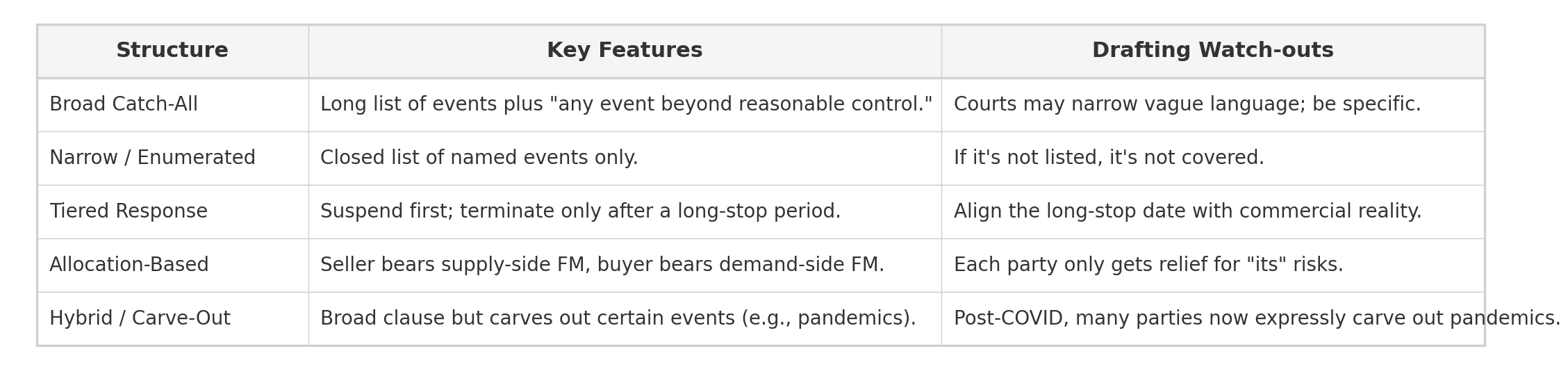
Negotiation Playbook
Key Drafting Notes
- Enumerated List vs. General Catch-All: Courts in the U.S. and U.K. interpret FM clauses narrowly. A pure catch-all ("any event beyond reasonable control") without an enumerated list gives courts discretion to exclude events the drafter intended to cover. Best practice: enumerate the specific events you care about (pandemics, cyber-attacks, government orders, sanctions), then add a catch-all as a safety net. The enumerated list anchors the clause; the catch-all captures edge cases. Post-COVID, always include "pandemic, epidemic, quarantine, or public health emergency" explicitly.
- Notice Period and Content Requirements: A 5-day notice period is aggressive but appropriate for time-sensitive supply contracts. A 10-day period is market standard. For construction or infrastructure, 15-30 days is reasonable given project complexity. Regardless of duration, require the notice to include: (a) a description of the FM event, (b) the expected impact on performance, (c) the steps being taken to mitigate, and (d) an estimated timeline for resumption. Insufficient notice content is a common basis for courts to deny FM claims.
- Mitigation Obligations Must Be Specific: "Commercially reasonable efforts to mitigate" is standard but vague. Consider adding specificity: the affected party must use alternative suppliers, reroute shipments, deploy backup systems, or reallocate resources. If mitigation is impossible, require the affected party to document why and report to the other party within a defined period. Courts have denied FM claims where the affected party sat idle and did not explore workarounds.
- Long-Stop Termination and Transition: The long-stop period (the duration after which either party can terminate) should reflect the nature of the contract. For SaaS and technology, 60-90 days is appropriate. For construction, 120-180 days. For long-term supply agreements, consider 180-365 days. Upon long-stop termination, address transition: the affected party should cooperate in transitioning services, return materials, and provide reasonable handover support. Do not leave termination mechanics to goodwill.
- Allocation of Risk During FM Events: In supply contracts, if the supplier has multiple customers and limited capacity during an FM event, who gets priority? Supplier-protective clauses allow sole-discretion allocation. Buyer-protective clauses require pro-rata allocation based on historical order volumes or contractual commitments. A balanced approach: "Supplier shall allocate available capacity on a pro-rata basis among customers with existing orders, provided that Buyer receives no less than its proportionate share based on the preceding 12 months of order history."
Common Pitfalls
- Foreseeability After COVID-19: Post-2020, pandemics are arguably foreseeable. Courts in several jurisdictions have held that contracts signed after early 2020 cannot invoke pandemic-related FM because the risk was known at signing. If you are entering a contract today and want pandemic coverage, either enumerate it explicitly with language confirming the parties accept the risk, or address it in a separate pandemic-specific provision with its own triggers and thresholds.
- Confusing FM with Material Adverse Change (MAC): FM deals with external events that prevent performance. MAC deals with deterioration in a party's financial condition or business prospects. A recession is a MAC event, not an FM event. A supply shortage caused by a government embargo is an FM event. Drafting a clause that conflates the two creates ambiguity courts will resolve against the drafter. Keep FM and MAC in separate clauses with distinct definitions.
- Failing to Exclude Payment Obligations: The single most common drafting error. If the FM clause does not explicitly carve out payment obligations, a party facing financial difficulty during an FM event (say, a pandemic-related revenue drop) may argue it is excused from paying. Courts have generally rejected this argument, but the litigation cost is significant. Always include: "For the avoidance of doubt, no Force Majeure Event shall excuse any Party's obligation to make payments that are due and owing."
- Ignoring Insurance Interaction: FM relief and insurance coverage can overlap. A party with business interruption insurance may still invoke FM to avoid performing, even though insurance covers its losses. Best practice: require the affected party to exhaust available insurance before claiming FM relief, and prohibit FM from excusing the obligation to maintain required insurance coverage. Otherwise, you create a moral hazard where the insured party benefits twice.
- No Periodic Reassessment Requirement: Many FM clauses suspend obligations but do not require the affected party to periodically reassess whether the event still prevents performance. This allows a party to invoke FM once and then coast. Add a requirement for periodic updates (every 14-30 days) confirming the FM event continues, the steps being taken to mitigate, and the expected timeline for resumption. If the affected party fails to provide updates, the suspension should lapse.
Key drafting notes for a Force Majeure clause:
- Specificity Over Generality: Courts in both the U.S. and U.K. interpret force majeure clauses narrowly. A generic "acts of God" catch-all may not cover a pandemic or a cyber-attack unless specifically listed. After COVID-19, best practice is to enumerate pandemics, epidemics, and quarantine orders explicitly.
- The Foreseeability Trap: If an event was foreseeable at the time the contract was signed, claiming force majeure becomes much harder. Post-2020, pandemics are arguably foreseeable - which is why many parties now carve them out or address them in separate pandemic-specific provisions.
- Payment Obligations: Most well-drafted clauses exclude payment obligations from force majeure relief. The logic: money can always be transferred, even if physical performance is blocked. Watch for clauses that don't make this exclusion - they can create a loophole where a party stops paying and hides behind a force majeure claim.
- Insurance Interaction: Force majeure relief and insurance coverage can overlap. Make sure the clause doesn't inadvertently excuse a party from claiming against its own insurance policy, and consider whether the insured party should be required to exhaust insurance proceeds before invoking force majeure.
- Material Adverse Change vs. Force Majeure: Don't confuse the two. MAC clauses deal with significant deterioration in a party's financial condition or business prospects. Force majeure deals with external events that prevent performance. A recession is a MAC event, not a force majeure event.
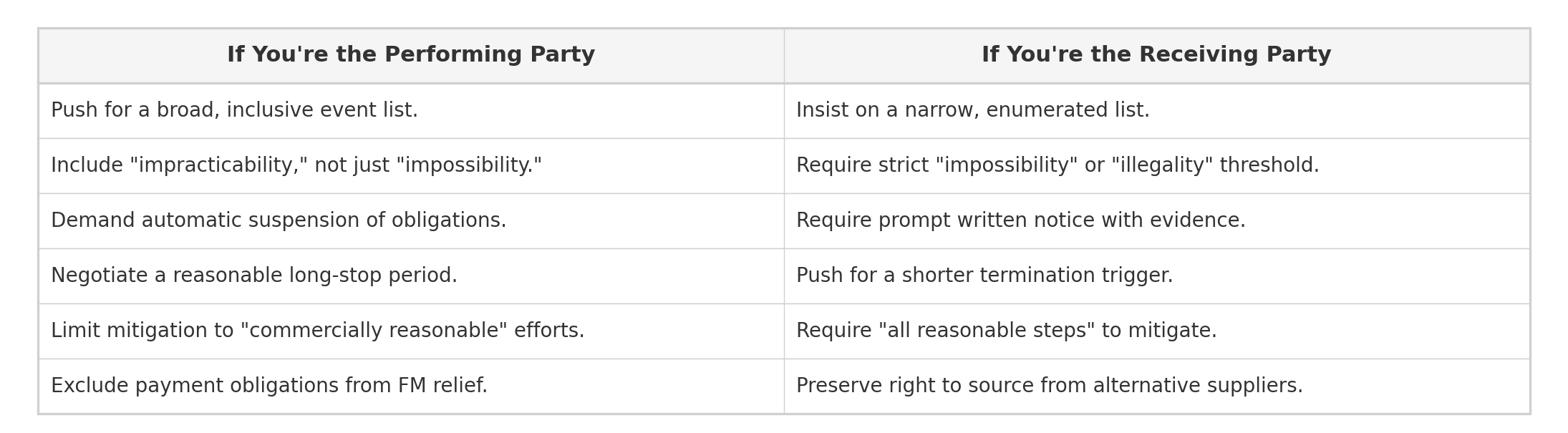
Historic note:
Force majeure originated in the Napoleonic Code (Article 1148), which excused a debtor from damages when performance was prevented by an "external cause" attributable to no fault. English common law developed a parallel doctrine - "frustration of contract" - after the landmark case Taylor v. Caldwell (1863), where a music hall burned down before a scheduled concert series. The court held the contract was discharged because the subject matter had been destroyed. But frustration is a narrow doctrine of last resort. It only applies when no force majeure clause exists, and it fully terminates the contract rather than suspending it. That's why commercial contracts in common law jurisdictions almost always include an express force majeure clause - to give the parties more control over outcomes than the blunt instrument of frustration allows. The COVID-19 pandemic produced the largest wave of force majeure litigation in modern history, with cases testing whether lockdowns, supply chain disruptions, and travel bans qualified under existing clauses.
Jurisdiction specific notes:
- U.S.: Force majeure is purely a creature of contract - there is no default statutory force majeure doctrine. If the contract doesn't include a force majeure clause, a party must rely on the common law doctrines of impossibility or impracticability (Restatement (Second) of Contracts Sections 261-265), or UCC Section 2-615 for goods. Courts interpret force majeure clauses strictly: if the specific event isn't listed, it's likely not covered. After COVID-19, New York courts held that pandemic-related shutdowns only triggered force majeure clauses that specifically mentioned pandemics, epidemics, or government orders.
- U.K.: Same principle - force majeure has no standalone common law existence; it must be expressly included in the contract. Without it, the only fallback is the doctrine of frustration, which is extremely difficult to establish and terminates the contract entirely (no suspension). English courts are equally strict about clause interpretation. In the Canary Wharf v. European Medicines Agency litigation around Brexit, the court rejected the EMA's force majeure and frustration arguments because the event (Brexit) was foreseeable. Lesson: draft your trigger events broadly, but don't assume a court will stretch vague language to cover the event that actually occurs.
.avif)